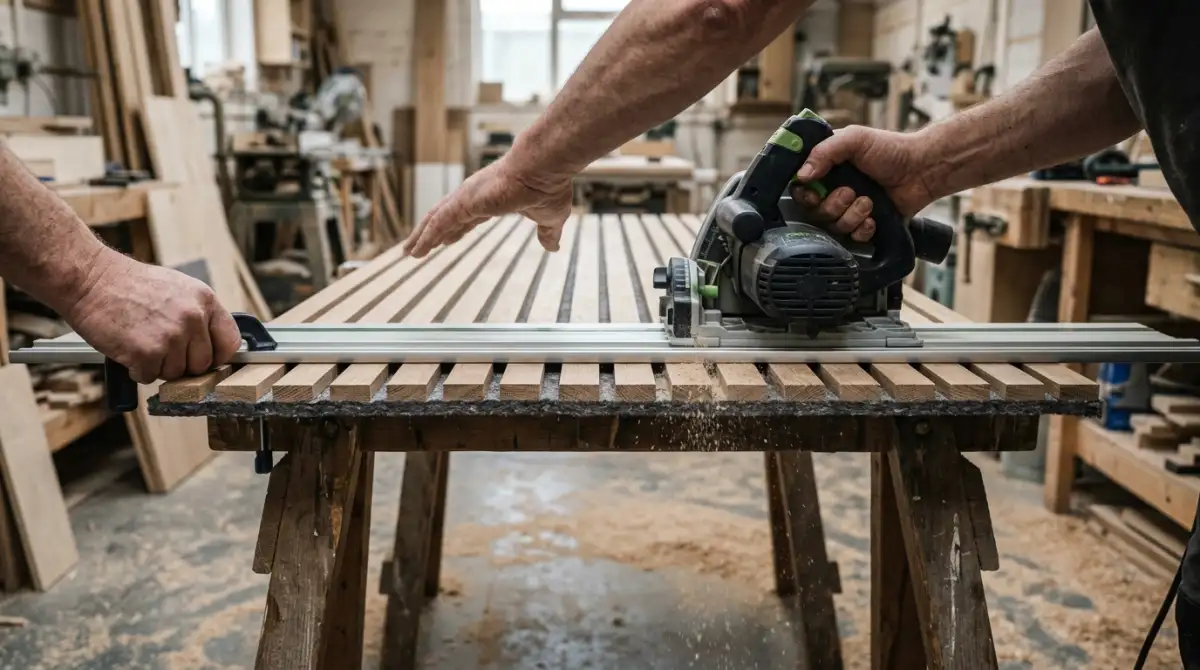
To cut acoustic slat panels, cut the MDF slats to length with a fine-tooth saw, supporting the panel and protecting the show face, then trim the felt with a sharp knife. Reduce the width by slicing the felt in a gap between slats. Mark socket openings from the face, and control dust with extraction and a suitable mask.
Key takeaways
- Length cuts go through slats and felt together: use a fine-tooth blade on a mitre saw or track saw.
- Width cuts usually need no saw: slice the felt along a slat gap with a sharp knife, in steps of one slat-and-gap repeat.
- Put the show face where the saw teeth enter the material, and tape the cut line to limit chipping.
- Socket openings are marked from the face, cut through slats with a multi-tool or jigsaw, then finished in the felt with a knife.
- MDF and wood dust are a health hazard: extract at source, vacuum with an M-class unit, and wear suitable respiratory protection.
Last reviewed: October 2026 by the Linegrain specification team.
What are you actually cutting?
An acoustic slat panel is two materials bonded together, and each needs a different approach. Linegrain’s standard panel is 2400 × 600 × about 21 mm, made of 12 mm MDF slats roughly 27 mm wide on a 9 mm PET felt backing, with gaps of about 13 mm between slats. That gives a slat-and-gap repeat of about 40 mm.
- The slats are MDF with a veneer, laminate or paint finish. They cut like any faced board: fine teeth, sharp blade, good support.
- The felt is a dense polyester fibre mat. A saw cuts it, but leaves a fuzzy edge; a sharp knife against a straight edge cuts it cleanly.
The table below matches each type of cut to the tools that work best.
| Cut | Best tools | Technique notes |
|---|---|---|
| Length (across the slats) | Mitre saw, plunge track saw, circular saw with guide rail | Fine-tooth blade; support both sides; face toward entering teeth; finish felt with a knife if fuzzy |
| Width (along a gap) | Utility knife and straight edge | Cut the felt in the centre of a gap; no saw needed; works in roughly 40 mm steps |
| Width (through a slat) | Track saw or table saw | Only when the layout requires a part slat; leaves a narrow slat that needs edge finishing |
| Socket and switch openings | Oscillating multi-tool, jigsaw with fine blade, knife | Mark from the face; cut slats first, then felt; check against the extension box |
| Scribing to an uneven wall or ceiling | Scribing tool or compass, jigsaw, block plane, sanding block | Transfer the profile to the slat ends; cut slightly proud and trim back |
| Angled cuts (sloping ceilings, stairs) | Mitre saw or track saw at the measured angle | Make a cardboard template first; mark every slat with the same angle line |
How do you cut slat panels to length?
- Measure at both edges. Floors and ceilings are rarely parallel. Measure the height at each side of the panel position, and allow a small gap at the floor and ceiling for trims or a shadow line.
- Mark across every slat. Use a square and a sharp pencil, or apply masking tape across the slats and mark on the tape.
- Choose which face goes up. Saw teeth chip the face where they exit. A mitre saw cuts downward, so the show face goes up. A handheld circular saw cuts upward through the board, so without a guide rail the show face goes down. A track saw spins the same way, but the rail’s splinter guard presses on the top face at the cut line, which is why track-saw users normally cut show face up.
- Support the whole panel. A 2.4 m panel will sag if supported at one end, which pinches the blade and splinters the last slat. Use trestles with a sacrificial board, or rigid foam insulation board under the full panel.
- Cut steadily. Let the blade do the work. A fine-tooth blade with a high tooth count leaves a clean slat end on veneered MDF.
- Tidy the felt. If the saw leaves loose fibres, trim them with a fresh knife blade. A quick light pass with fine abrasive takes any whiskers off the slat edge.
On a mitre saw, a standard 600 mm wide panel may be wider than the saw’s crosscut capacity. In that case, either cut the felt along a gap and cut the two halves separately, or use a track saw.

How do you cut slat panels to width?
This is where slat panels are much easier than solid boards. Because the slats are only joined by the felt, you can reduce the width by cutting the felt along the centre of a gap:
- Lay the panel face down on a clean, flat surface.
- Find the gap where you want to split the panel. From the back you can feel the slats through the felt, or mark the gap from the front first.
- Place a straight edge along the line and cut through the felt with a sharp utility knife in two or three passes, not one hard pass.
- Keep the knife vertical so the felt edge is square; a neat felt edge matters where it will meet the next panel.
With a 40 mm repeat, a 600 mm panel can be reduced in roughly 40 mm steps without touching the timber. Plan the layout so end pieces land on a gap where possible. If the wall needs a width that falls on a slat, decide whether a narrow part-slat looks acceptable at that position or whether it is better to adjust the start point and split the difference at both ends. See acoustic panel sizes and how to plan coverage for layout arithmetic.
How do you cut around sockets and switches?
- Isolate the circuit and remove the faceplate.
- Measure the box position from the edge of the previous panel and from the floor or ceiling. Measure twice and mark both box edges.
- Transfer the marks to the panel face. Many installers make a cardboard template of the box first.
- Cut the slats crossing the opening with an oscillating multi-tool or a fine jigsaw blade, staying just inside the line.
- Cut the felt behind with a knife to the same outline.
- Test-fit the panel over the box before fixing. The opening should be hidden by the faceplate, with no gaps showing.
- Bring the accessory forward to the new wall face with a suitable extension box, so the faceplate sits flat and is properly supported. If you are not competent with electrical work, use an electrician.
Where possible, adjust the layout so the socket falls within a gap and only one or two slats need to be notched. That keeps the cut small and the slat line uninterrupted. The full fitting sequence is in how to fit acoustic wall panels.
Cutting curves, columns and odd shapes
For curved walls and round columns, standard rigid panels need to be cut into narrow strips or replaced by a product designed to bend. A flexible acoustic slat panel uses a backing that wraps convex curves, which avoids dozens of cuts on site. For angled ends at stair strings or sloping ceilings, make a template from cardboard, transfer the angle to each slat, and cut on a mitre saw so every slat end matches.

How do you control dust when cutting MDF slat panels?
Cutting MDF slats produces fine wood dust, and that is a genuine health risk rather than a housekeeping issue. The International Agency for Research on Cancer (WHO) classifies wood dust as carcinogenic to humans, linked to cancer of the nasal cavities and sinuses. In the US, OSHA notes that airborne wood dust may cause allergic and non-allergic respiratory symptoms and cancer, and regulates it under its limits for Particulates Not Otherwise Regulated.
In Great Britain, the Health and Safety Executive sets a workplace exposure limit of 3 mg/m³ for hardwood dust and 5 mg/m³ for softwood dust, both as 8-hour time-weighted averages, and where hardwood and softwood dusts are mixed, the hardwood limit applies to the whole mixture. HSE’s woodworking hazard guidance lists MDF among the wood composites covered and sets out the main controls.
Practical dust controls on site
- Cut outside or in a dedicated cutting area rather than in the finished room.
- Use on-tool extraction: connect the saw or multi-tool to a dust extractor, rather than relying on the tool’s own bag.
- Clean up with a vacuum rated at least dust class M. HSE advises never to sweep or use compressed air, because it puts fine dust back into the air.
- Wear respiratory protection as a backup to extraction, not a substitute. HSE indicates a mask with an assigned protection factor of 20, such as an FFP3 disposable mask, is typically needed for machining and short dusty tasks. Tight-fitting masks need a face-fit test and a clean-shaven seal.
- Protect your eyes and ears. Safety glasses for all cutting; hearing protection for prolonged saw use.
For projects where the client wants to reduce indoor emissions from the MDF itself, Linegrain can supply E0, CARB P2 or other board grades on request; see our guide to MDF formaldehyde grades.
How can you reduce cutting on site?
Every cut on site costs time, creates dust and risks a damaged panel. On larger projects, you can cut much of it out at the order stage:
- Order the right length. If the room is 2.7 m or 3 m high, a 2700 or 3000 mm panel removes the need to join panels vertically. See the extended-height 3000 mm slat panel.
- Plan widths in slat repeats so end panels split along a gap.
- Order trims and end caps in the same finish so cut ends are covered rather than touched up.
- Allow a small spare quantity for mistakes and future repairs, from the same production batch.
FAQ
What is the best saw for cutting acoustic slat panels?
For cutting panels to length, a mitre saw or a track saw with a fine-tooth blade gives the cleanest edge on MDF slats with veneer or laminate. A plunge track saw is the most versatile on site because it handles full 600 mm widths in one pass. Use a sharp utility knife for the felt and a multi-tool or jigsaw for openings.
Can you cut acoustic slat panels with a knife?
You can cut the felt backing with a knife, which is how you reduce panel width: slice the felt along the gap between two slats. You cannot cut the MDF slats themselves with a knife; they need a saw.
How do you stop the veneer chipping when cutting slat panels?
Use a sharp blade with a high tooth count, support the panel fully on both sides of the cut, apply masking tape along the cut line, and put the show face on the side where the teeth enter the material. On a mitre saw that is face up; on a handheld circular saw without a rail, face down. A track saw’s splinter guard protects the top face, so cut show face up.
Is MDF dust from cutting acoustic panels dangerous?
Wood dust, including dust from MDF and other wood composites, is a recognised health hazard. HSE sets a workplace exposure limit for hardwood dust of 3 mg/m3 and recommends extraction at source, an M-class vacuum and suitable respiratory protection. Never sweep up or blow dust away with compressed air.
Want fewer cuts on site? Send us your wall heights and layouts, and we will quote slat panels in the lengths and finishes that fit, with matching trims. Request a quote.