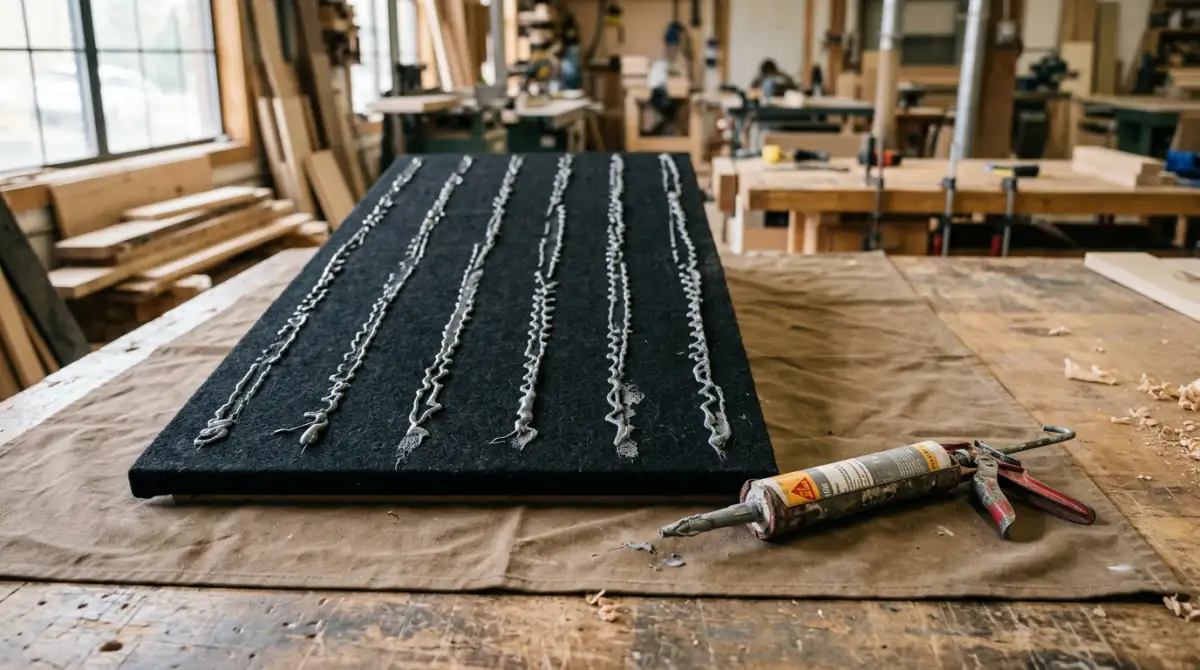
The best adhesive for acoustic wall panels is usually a hybrid or MS polymer grab adhesive that the manufacturer approves for your wall surface, used together with screws into studs or battens. Solvent-based grab adhesives suit porous surfaces. Never rely on adhesive alone overhead, and always test on a panel offcut first.
Key takeaways
- Hybrid or MS polymer adhesives bond to most porous and non-porous building surfaces and are the usual first choice for slat and felt panels.
- Solvent-based grab adhesives work well on porous surfaces but have more restrictions; check the data sheet.
- The bond is only as strong as the surface layer: loose paint, dust or flaky plaster will fail first.
- Ceilings need mechanical fixings; adhesive alone overhead is not safe.
- Choose by substrate and data sheet, not by brand reputation, and test on an offcut.
Last reviewed: October 2026 by the Linegrain specification team.
Why there is no single best adhesive
Search results for the best adhesive for acoustic panels often name one product. In practice, the right product depends on three things: what the panel’s back is made of, what the wall is made of, and how the panel will be loaded. A slat panel’s back is a PET felt mat; a fabric-wrapped panel may have a rigid fibreglass or mineral core; a PET felt acoustic wall panel is felt all the way through. The wall might be fresh plaster, painted plasterboard, tiles, plywood or bare masonry.
So this guide does not crown a brand. It explains the adhesive families, what their technical data sheets say, and how to match them to your job. Where we name products, they are examples of a documented chemistry, not endorsements.
What types of adhesive are used for acoustic panels?
Hybrid and MS polymer grab adhesives
These are moisture-curing, one-part adhesives based on silane-modified polymers. They are often sold as “hybrid polymer”, “MS polymer” or “fix-all” adhesives. Their main appeal for acoustic panels is broad substrate compatibility. The Sika Multi Stick data sheet, for example, describes a grab adhesive based on hybrid polymer technology with primerless adhesion to most common porous and non-porous building substrates, including plasterboard, brick, concrete, timber, metals and hard plastics. The Soudal Fix ALL High Tack data sheet describes a modified silane polymer that is free of isocyanates and silicone.
The limits matter just as much. The Soudal sheet lists polyethylene, polypropylene, PTFE, bitumen and copper among unsuitable substrates. Hybrid adhesives cure from the outside in by reacting with moisture in the air, so curing depth over time is limited: Sika quotes 1 to 3 mm per 24 hours at 23 °C and 50% relative humidity, with application between +5 and +35 °C. Thick, wide beads trapped between a felt back and a non-porous wall will take longer to cure fully.
Solvent-based grab adhesives
Traditional solvent-borne gap-filling adhesives grab quickly and fill uneven surfaces. The Evo-Stik Gripfill technical data sheet (Bostik) describes a solvent-borne, filled rubber resin adhesive for bonding boards to brick, block, concrete, plaster and plasterboard. It also sets out constraints that matter for panels: porous surfaces such as plaster should be primed with diluted PVA first; it is not for foamed PVC or expanded polystyrene; wall panels should be adjusted within five minutes of placing; and the bond should be left to dry overnight before further work. The listed flashpoint is below 10 °C, so ventilation and ignition sources need attention indoors.
Water-based and other adhesives
Water-based panel adhesives and contact adhesives also exist. Water-based products need at least one porous surface to dry out. Two-part epoxies are strong but rarely practical for full-size wall panels. For most slat panel jobs, the choice comes down to hybrid polymer or solvent-based grab adhesive, plus screws.
Adhesive types compared
| Property | Hybrid / MS polymer grab adhesive | Solvent-based grab adhesive |
|---|---|---|
| Cure mechanism | Reacts with moisture in the air | Solvent evaporates |
| Substrates | Most porous and non-porous building surfaces (check exclusions) | Best with at least one porous surface; primer advised on plaster |
| Initial grab and adjustment | Varies by product; high-tack versions reduce the need for temporary support | Fast grab with a short adjustment window (five minutes on wall panels for Gripfill) |
| Handling indoors | Check the safety data sheet; isocyanate- and silicone-free versions exist | Solvent-borne with a low flashpoint; ventilate and remove ignition sources |
| Cured state | Elastic | Varies by product; see the data sheet |
| Typical use with slat panels | Default choice on painted plaster, plasterboard, tiles, plywood | Bare porous plaster, masonry, timber battens |
| Overhead | Only with mechanical fixings | Only with mechanical fixings |
How do you match the adhesive to the wall?
- Painted plaster or plasterboard: the bond holds only as well as the paint holds to the wall. Scrape a test area; if the paint lifts easily, screw the panels into studs or battens. Well-adhered emulsion can be a workable surface, but always run a test bond.
- Fresh plaster: let it dry fully. Dusty plaster needs a primer; both the Sika and Bostik sheets recommend diluted PVA on dusty or porous surfaces.
- Bare masonry and concrete: usually uneven. Battens with mechanical fixings give a flat plane; adhesive is optional.
- Tiles, glass and gloss paint: non-porous. A hybrid polymer adhesive that lists these surfaces is the better choice; clean and degrease first.
- Plywood, OSB, MDF and timber battens: good surfaces for both adhesive families.
- Wallpaper and vinyl coverings: remove them. Adhesive bonded to wallpaper is only as strong as the wallpaper paste.

When should you use screws instead of adhesive?
For acoustic slat panels, screws are the primary fixing on most projects, and adhesive is an aid. Use screws, with or without adhesive, when:
- the wall is uneven, dusty, freshly painted or of unknown condition;
- the panels may be removed or relocated later;
- the panels go onto battens to create an air gap or a cavity for insulation;
- the installation is in a public or commercial space where a failed bond would be a hazard;
- the panels are longer or heavier than standard, such as 3000 mm lengths;
- the panels are on a ceiling or a sloping soffit.
Slat panels make screw fixing easy to hide: the screw goes through the felt in a gap between slats, so the head sits in the shadow line. See how to fit acoustic wall panels for the full method.
Why ceilings should never be adhesive-only
On a wall, gravity loads an adhesive joint in shear. On a ceiling, it pulls the panel straight off the surface, continuously, and any weakness in the paint, plaster or adhesive bond leads to a falling panel. Adhesive manufacturers are explicit about this. The Everbuild Multi Stick data sheet states that overhead applications should always use mechanical fixings, and that heavy items need temporary support until the adhesive has cured; the Everbuild Pinkgrip MS data sheet gives the same instruction for overhead work.
For ceilings, fix panels with screws into joists or a secure batten grid, or choose a system designed to hang, such as acoustic ceiling baffles, clouds and slat ceilings. More detail is in our guide to acoustic panels on ceilings.

How to apply adhesive to a slat panel
- Prepare the wall. Clean, dry, dust-free and sound. Prime dusty or very porous surfaces if the data sheet says so.
- Test first. Bond a small offcut of the actual panel to the actual wall and leave it to cure. Try to pull it off. If the paint comes away rather than the adhesive, the paint is the weak link.
- Apply in vertical beads on the felt back, behind the slat lines, keeping clear of the panel edges so adhesive does not squeeze into the joints.
- Do not over-apply. More adhesive is not stronger if it cannot cure; follow the bead size and spacing in the data sheet.
- Press into place within the open time, check plumb, and adjust within the window the data sheet allows.
- Screw-fix through the felt in the gaps into studs or battens while the adhesive cures.
- Clean excess immediately with the solvent or wipe the manufacturer specifies; cured adhesive must be removed mechanically.
Fire and project specifications
On commercial projects, the reaction-to-fire classification usually applies to the whole wall lining, not just the panel. If the project requires a classified system, check whether the panel’s fire test was carried out with a specific adhesive or fixing and replicate it. Linegrain offers a fire-rated acoustic slat panel with fire-retardant MDF, and shares fire and acoustic test reports for the specific build quoted. See our guide to acoustic panel fire ratings.
FAQ
What is the best adhesive for acoustic wall panels?
There is no single best brand. For slat and felt panels, a hybrid or MS polymer grab adhesive is the usual first choice because it bonds to most porous and non-porous building surfaces and stays slightly flexible. Choose a product whose data sheet lists your wall substrate, and test it on an offcut of the panel first.
Can I use only adhesive to fix acoustic slat panels to a wall?
On a flat, clean, sound wall with an adhesive approved for that surface, adhesive alone can hold a wall panel. Most installers still add screws through the felt into studs or battens, because the screws hold the panel while the adhesive cures and remain secure if the paint or plaster layer fails.
Can I glue acoustic panels to a ceiling?
Not with adhesive alone. Adhesive manufacturers’ data sheets for grab adhesives state that overhead applications must be combined with mechanical fixings. Fix ceiling panels with screws into joists or a batten grid; adhesive may be added as a secondary measure.
Will grab adhesive damage the wall when panels are removed?
Usually, yes, to some extent. Cured grab adhesive grips the surface layer, so removing a bonded panel often pulls off paint or plaster skim. If the panels may be moved later, fix them with screws only, or fit them to battens that can be unscrewed.
Specifying panels and fixings for a project? Tell us the wall build-up and finish, and we will quote the right panel build with its test reports. Request a quote.