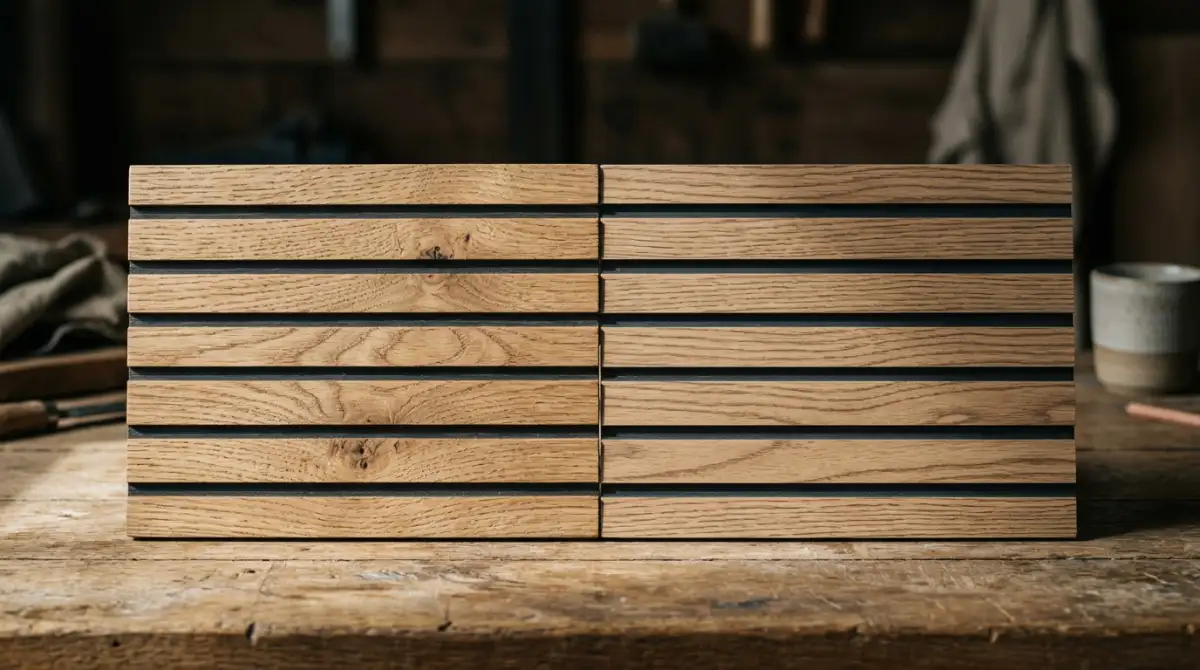
Real wood veneer slat panels have a thin slice of timber over an MDF core, so every slat shows genuine grain, ages naturally and can be touched up. Laminate slat panels use a printed décor paper or film: very even colour and a hard-wearing surface, but no refinishing. Choose veneer for character, laminate for consistency.
Key takeaways
- Veneer is real timber, so grain and colour vary between slats and change with light exposure; laminate is a printed décor and repeats exactly.
- Laminate faces are generally harder-wearing and easier to clean; veneer is easier to repair locally with stain and lacquer.
- Cost depends on species, veneer cut and matching, finishing steps and order size more than on the face type alone.
- Both faces sit on the same MDF core, so fire class and formaldehyde grade depend on the core and the tested build, not just the face.
- Approve a physical sample of the exact face and finish before production, and order spare panels from the same batch.
Last reviewed: October 2026 by the Linegrain specification team.
What is the difference between veneer and laminate on a slat panel?
An acoustic slat panel is a set of MDF slats fixed to a PET felt backing. The slats need a decorative face, and that face is either real timber or a reproduction of it.
Real wood veneer is a thin sheet sliced or peeled from a log, glued to the MDF slat and then sanded, stained if required and sealed with lacquer or oil. Because it is cut from a tree, no two leaves are identical. Veneer suppliers describe this variation openly: the States Industries veneer specification brochure notes that wood species is the primary determinant of colour and grain, and that lower veneer grades allow unlimited colour variation.
Laminate is a general term in the panel trade for a manufactured decorative surface. On slat panels it is usually a printed décor paper impregnated with melamine resin, or a decorative film (PVC or PET) wrapped around each slat. Melamine-faced boards for interiors are covered by BS EN 14322, which sets surface requirements and classifies the boards by abrasion resistance. The décor can imitate oak, walnut or any other species, or be a plain colour such as black or grey.
How do veneer and laminate slat panels compare?
| Factor | Real wood veneer | Laminate (décor paper or film) |
|---|---|---|
| Appearance | Genuine grain, depth and texture; each slat differs | Printed grain or flat colour; pattern repeats |
| Colour consistency | Varies within a batch and between batches | Very even across slats and between production runs |
| Ageing | Colour shifts with light exposure over time | Generally stable, depending on the décor and film |
| Surface wear | Depends on the lacquer; softer than melamine | Hard, abrasion-resistant surface; easy to wipe |
| Repair | Scratches and edge damage can be touched up with stain, wax or lacquer | Difficult to repair invisibly; damaged slats usually replaced |
| Cut edges on site | Edge shows MDF; can be stained to blend | Edge shows MDF; needs a trim or colour-matched edge treatment |
| Cost drivers | Species, cut, matching, sanding and lacquer steps | Décor choice, wrapping process, order size |
| Typical use | Hotels, boardrooms, premium homes, feature walls | Offices, retail, rental property, high-traffic areas |
How do they look on the wall?
From across a room, a good oak-effect laminate and an oak veneer can look similar. Up close, and under raking light from windows or wall washers, the difference shows. Veneer has real pores and figure that catch the light; the grain changes from slat to slat, and the surface has slight depth under a satin lacquer. A printed décor is flat, and on a long wall you may spot the same knot or figure repeating.
The cut of the veneer changes the look as well. According to the States Industries brochure, plain slicing produces a “cathedral” grain, quarter slicing produces straight stripes, and rift cutting at an angle reduces the ray flake seen in oak. Rotary peeling gives a wide, open grain. On narrow slats around 27 mm wide, straight-grained quarter or rift veneers tend to look calmer, while plain-sliced cathedral figure gives a more rustic wall.

Plain colours are where laminate is strongest. A black or grey slat wall needs every slat to match exactly, and a stained veneer will always show some grain and colour difference through the stain. That is why black slat panels often use a laminate or foil face, although black-stained veneer is chosen when the client wants visible grain.
How consistent is the colour between batches?
This is the most common source of complaints on large projects. With veneer, colour varies within a single log, between logs and between harvests. Good suppliers sort and mix slats so a wall reads as even overall, but they cannot remove natural variation, and a re-order months later will not match the first batch exactly.
Light exposure adds a second change. Research by the US Forest Service and collaborators shows that wood surfaces change colour under light, with UV and violet wavelengths causing yellowing and blue light able to bleach the surface (Kataoka et al., Holzforschung, 2007). The authors recommend that protective finishes absorb both UV and violet light. In practice, a veneer wall next to a south-facing window will drift in tone over months, and a replacement panel fitted later will look newer until it catches up.
Laminate décors are printed to a colour standard, so slats from different runs normally match closely. Even so, décor papers and films are produced in batches; ask for the batch reference to be recorded so a re-order can request the same one.
For both types, the practical rules are the same: approve a physical sample of the exact face, cut and finish, keep a signed reference sample, and order spare panels with the main order so repairs come from the same batch. Sample cost and shipping are quoted by our team depending on the items and quantity; see samples and lead times.
Which is more durable?
Durability depends on the face and on the finish layer above it.
Surface wear and cleaning
Melamine laminate surfaces are hard and resist abrasion; BS EN 14322 classifies melamine-faced boards by abrasion resistance, so a supplier can state a class. Laminate wipes clean with mild detergent and tolerates frequent cleaning in offices and retail. Veneer relies on its lacquer for protection. A good two-coat lacquer handles normal contact, but keys, bags and chair backs will mark it faster than melamine.
Impact and edges
Both faces sit on MDF, so a hard knock dents either one. Film-wrapped slats can lift at a damaged edge; veneer can chip at the arris. Slat walls in corridors and behind seating benefit from a skirting, a dado-height break or a different finish below about 1 m (3 ft 3 in).
Moisture and heat
Neither face makes the panel suitable for wet areas. Moisture behaviour is set by the MDF core, so specify moisture-resistant MDF for humid rooms and keep panels away from direct water. Check that film-wrapped slats are kept away from radiators and other heat sources, as some films soften with heat.
How easy is it to repair each type?
Veneer is the easier face to repair invisibly. Light scratches can be blended with a stain pen or wax filler and a touch of lacquer; a chipped edge can be filled and coloured. Because veneer is thin, heavy sanding is not an option, but local touch-ups usually work.
Laminate is harder to repair. Colour-matched filler pens help with small chips, but a deep scratch through the décor shows the paper or core beneath. The usual fix is to replace the slat or the whole panel, which is easier when spares from the same batch are in stock.
Cut edges on site behave in a similar way. When you trim a panel to length, both types expose raw MDF at the cut. On veneer you can stain the edge to blend; on a plain-colour laminate you will need a trim, an end cap or a colour-matched paint. Our guide on how to cut acoustic slat panels covers clean cuts and edge treatment.
What drives the cost difference?
Face type alone does not decide price. The main cost drivers are:
- Species: walnut and other premium hardwood veneers usually cost more than oak or ash; décor papers and films vary less by “species”.
- Veneer cut and matching: quarter and rift cuts give less usable veneer per log than plain slicing or rotary peeling, so they usually carry a premium. Careful grain matching across slats adds labour.
- Finishing steps: veneer needs sanding, optional staining and lacquer coats with drying time; laminate faces arrive finished.
- Order size per finish: set-up costs are spread over the quantity. Linegrain’s minimum for slat panels is 100 panels per finish, and mixed containers are allowed.
- Core upgrades: fire-retardant, moisture-resistant, E0 or CARB P2 MDF add cost for either face.
Ask for quotes on both faces for the same size and quantity to see the real gap.
Does the face affect fire ratings and formaldehyde compliance?
Yes, both. A fire classification belongs to the tested build, and the face and its finish are part of that build, so a report for a laminate face does not automatically cover a lacquered veneer. See our guide to fire rated acoustic panels.
For US shipments, veneered panels can also fall under the TSCA Title VI “laminated product” provisions. The EPA small entity compliance guide states that from 22 March 2024 non-exempt laminated products become hardwood plywood and must meet panel producer requirements. Our article on E1, E0 and CARB P2 MDF explains what that means for importers.
Which should you choose for your project?
- Choose real wood veneer for hotel lobbies, boardrooms, restaurants and premium homes, where natural grain is the point and staff can look after small repairs. Oak, walnut and smoked oak are typical.
- Choose laminate for offices, retail, rental and student housing, and anywhere that needs plain colours, tight colour matching across large areas, or frequent cleaning.
- Mix them when budget is tight: veneer on the feature wall at reception, laminate in corridors and back-of-house.

Browse the acoustic slat panel range, from natural oak to walnut, and tell us which face your project needs so we can confirm the options for each finish.
FAQ
Can you tell veneer from laminate by looking at it?
Usually, yes, up close. Veneer has real pores, grain that changes from slat to slat and a slight depth under the lacquer. A printed décor is flat and its pattern repeats. Look along the wall in raking light and compare several slats side by side.
Do veneer slat panels change colour over time?
Yes. Real wood changes colour under light; research from the US Forest Service and partners found that UV and violet light yellow wood surfaces while blue light can bleach them. Expect gradual change, especially near windows, and buy spare panels with the original order.
Is laminate or veneer better for an office?
Laminate is often the practical choice for busy office areas because it is hard-wearing, easy to clean and colour-consistent across large floors. Veneer works well for reception, boardrooms and client-facing spaces where appearance matters most.
Does the face change the acoustic performance?
Very little. Sound absorption in a slat panel comes mainly from the PET felt exposed in the gaps and from any cavity behind it. The slat face, whether veneer or laminate, reflects sound in a similar way.
Not sure whether veneer or laminate suits your project? Send us the location, quantity and look you want and we will recommend a face and finish. Request a quote.